Saving tips for a home battery for solar panels
By Laurens Arends · updated 05-10-2026
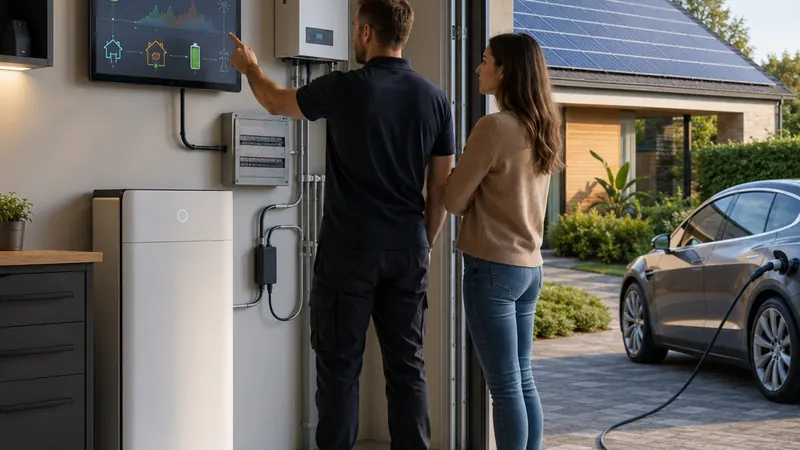
Home battery for solar panels is rarely interesting in 2026
As long as you can fully net meter, a stored kilowatt hour has the same value as a kilowatt hour fed back. Storing fully nettable electricity does not in itself yield any price advantage. Lower feed-in charges can, however, deliver a limited saving.
At the same time, the battery causes losses. At 6 kWh, 200 full cycles and 90 percent efficiency, you charge 1.200 kWh a year and get 1.080 kWh back. The missing 120 kWh is worth about € 32,40 (2026). With a plug-in battery of 2,5 kWh that is € 13,50, and with a 10 kWh battery it is € 54.
Recalculate from 2027
On 1 January 2027 net metering ends and a home battery can become interesting. For 2027, Vereniging Eigen Huis calculates with € 0,21 per kWh consumed from the grid and a net feed-in fee of € 0,005. At 200 cycles and 90 percent efficiency, 6 kWh then yields 1.080 kWh of usable electricity: 1.080 × € 0,21 minus 1.200 × € 0,005 = € 220,80.
The same sum gives € 92 for a plug-in battery of 2,5 kWh and € 368 for 10 kWh. A larger battery only saves more if you actually fill and empty it often. As a result, the payback period is often better with a smaller battery.
Earn by charging during cheap hours
With a dynamic energy contract you let the battery charge during cheap hours and use the electricity during the evening peak. The price difference must be large enough to absorb the loss in the home battery itself. In March 2026, according to Gridio, the difference between the Dutch afternoon price and the evening peak averaged € 0,071 per kWh.
After storage loss, we calculate conservatively with € 0,03 to € 0,06 net benefit. At 200 cycles, that yields € 30 to € 60 with 5 kWh, € 60 to € 120 with 10 kWh and € 90 to € 180 with 15 kWh. The energy tax does not change. A negative wholesale price therefore does not automatically mean free electricity.
Home battery and solar panels: avoid feed-in charges
According to Vereniging Eigen Huis, eight solar panels produce about 3.000 kWh per year. If a battery increases your own consumption from 30 to 60 percent, the feed-in drops from 2.100 to 1.200 kWh. In our calculation model, the feed-in charges amount to € 280 per year.
A proportional drop gives 900 ÷ 2.100 × € 280 = € 120 saving. Note, though: suppliers often work with tariff bands. If you stay in the same band, you save nothing. In addition, the efficiency of the battery has not yet been taken into account here, so the saving will in any case be somewhat lower.
Read also: Combine your home battery with a dynamic energy contract
Buying a home battery? Zendure supplies home batteries for solar panels and balcony panels, with the app for charging during cheap hours.
View home batteries at Zendure ›If you buy something from Zendure via that button, we receive a fee; that changes nothing about the price or our explanation, see our how we make money.
Place it safely and register the battery and solar panels
Place a fixed battery in a dry, cool and ventilated room, outside the escape route. The fire service also recommends a smoke alarm, a stable non-combustible surface and sufficient free space. Connect a plug-in battery directly to an earthed socket, without an extension lead, and place a maximum of one battery per circuit.
According to the Consumentenbond, a plug-in battery may deliver a maximum of 800 watts per socket. Register the battery and solar panels at Energieleveren.nl. Also check your policy: according to WA.nl, cover and installation conditions differ per insurer, and a separate plug-in battery may fall under the home contents insurance.
Is a home battery interesting with a company car?
The Belastingdienst allows the employer to reimburse your actual integral electricity costs. Another possibility is working with a pre-agreed, market-based rate. If the actual costs are reimbursed, cheap charging yields no personal benefit: a lower cost price also means a lower reimbursement.
With a price agreement, that can be different. With 2.000 business charging kWh, every cent of difference between your charging costs and the employer's reimbursement yields € 20 per year. A difference of € 0,04 therefore means € 80 gross benefit, before storage loss and battery wear.
Preferably charge solar power directly into the car. According to Milieu Centraal an electric car has on average about 60 kWh of battery capacity, compared with 2,5 kWh for a typical plug-in battery and 6 kWh for an average fixed home battery. Charging directly avoids an extra round of charging and discharging. Do keep track of the business charging sessions separately, though. Any energy surpluses can be stored in the home battery and later used for charging the company car.
What does a home battery for solar panels really deliver?
For this calculation we use a representative Dutch household. According to Milieu Centraal, a household uses on average 2.430 kWh of electricity per year. We combine that with eight solar panels that, according to Vereniging Eigen Huis, generate about 3.000 kWh per year.
Without a battery, a household uses on average 30 percent of the solar power directly. That is 900 kWh. The remaining 2.100 kWh goes to the electricity grid. According to Vereniging Eigen Huis, a well-matched home battery can increase own consumption to about 60 percent, or 1.800 kWh. In this example, the battery therefore delivers a maximum of 900 kWh of extra solar power to the home.
Energy is lost during charging and discharging. For usable battery capacity, the Consumentenbond calculates with about 85 to 90 percent efficiency. We use 90 percent. To get 900 kWh out of the battery, you therefore have to store 1.000 kWh of solar power.
A larger battery does not automatically deliver more
In our example, a plug-in battery of 2,5 kWh can complete 200 full cycles. With it you store 500 kWh and, after the storage loss, get 450 kWh back. Own consumption then rises from 30 to about 45 percent.
A 6 kWh battery only needs to complete about 167 full cycles to store 1.000 kWh. That already reaches the limit of 60 percent own consumption. A 10 or 15 kWh battery can store more on sunny days, but is more often partly empty during the rest of the year. With the same solar panels and the same household consumption, that larger capacity therefore yields no extra annual saving in our base scenario. The larger capacity only makes the home battery more expensive and will needlessly extend the payback period.
| Battery | Version | Stored solar power | Electricity back from battery | Full cycles per year | Own solar power used |
|---|---|---|---|---|---|
| 2,5 kWh | Plug-in battery | 500 kWh | 450 kWh | 200 | About 45% |
| 6 kWh | Fixed system | 1.000 kWh | 900 kWh | About 167 | About 60% |
| 10 kWh | Fixed system | 1.000 kWh | 900 kWh | About 100 | About 60% |
| 15 kWh | Fixed system | 1.000 kWh | 900 kWh | About 67 | About 60% |
These values only apply to the data we used. With more solar panels, a heat pump, an electric car or a different consumption pattern, a larger battery can indeed process more energy. With a small solar roof or a home that already uses a lot of electricity during the day, the extra storage actually turns out lower.
Return on a home battery for solar panels in 2026
Up to and including 31 December 2026 you can net meter solar power. Storing a kilowatt hour therefore does not in itself yield any price advantage. Due to the storage loss, your netted quantity even becomes slightly smaller. In 2026, however, a battery can prevent feed-in charges. The CBS calculated in January 2026 with an average of € 0,126 in feed-in charges per kWh fed back.
With a plug-in battery, the feed-in in our example drops by 500 kWh. That theoretically avoids 500 × € 0,126 = € 63 in feed-in charges. From that, € 13,50 is deducted due to 50 kWh of storage loss at € 0,27 per kWh. The net saving thus becomes about € 50 per year.
With the larger batteries, the feed-in drops by 1.000 kWh. The avoided costs are then € 126. The storage loss of 100 kWh costs € 27, leaving about € 99. In reality, many suppliers work with tariff bands. If you stay in the same band after installation, the saving can turn out much lower or even negative.
Return on a home battery for solar panels without net metering (from 2027)
From 1 January 2027 the net metering scheme ends. Solar power you use yourself then avoids the full consumption price, while feeding back only yields a fee. For this scenario we use the calculation values of Milieu Centraal and Vereniging Eigen Huis: € 0,21 per kWh consumed from the grid and a net feed-in value of € 0,005 per kWh after feed-in charges. With a plug-in battery you avoid purchasing 450 kWh: 450 × € 0,21 = € 94,50.
At the same time, you miss out on the fee for 500 kWh: 500 × € 0,005 = € 2,50. The annual saving therefore amounts to about € 92. A well-matched 6 kWh battery delivers 900 kWh to the home. The calculation then becomes 900 × € 0,21 minus 1.000 × € 0,005 = € 184 per year. A 10 or 15 kWh battery in the same average household likewise stays at around € 184, because the available solar power and the evening consumption are the limiting factors.
Purchase price, lifespan and annual return
For the purchase prices we use average calculation prices within the current market ranges. According to Vereniging Eigen Huis, a plug-in battery of 2 kWh costs about € 500 to € 1.000. For 2,5 kWh we calculate with € 900. The Consumentenbond gives € 4.000 to € 6.000 for an average fixed system, including installation and VAT. For 10 and 15 kWh we use the middle of the market ranges that Zonneplan published in 2026.
According to the Consumentenbond, a home battery lasts on average about fifteen years. To show the real annual return, we therefore spread the purchase price over fifteen years. Maintenance, financing costs, subscriptions, capacity loss and a defect outside the warranty have not been included.
| Capacity | Indicative purchase price | Annual depreciation over 15 years | Saving with net metering in 2026 | Return 2026 | Saving from 2027 | Return from 2027 | Net per year after depreciation from 2027 |
|---|---|---|---|---|---|---|---|
| 2,5 kWh plug-in | € 900 | € 60 | About € 50 | 5,5% | About € 92 | 10,2% | + € 32 |
| 6 kWh fixed | € 5.000 | € 333 | About € 99 | 2,0% | About € 184 | 3,7% | − € 149 |
| 10 kWh fixed | € 6.500 | € 433 | About € 99 | 1,5% | About € 184 | 2,8% | − € 249 |
| 15 kWh fixed | € 9.750 | € 650 | About € 99 | 1,0% | About € 184 | 1,9% | − € 466 |
The return in the table is the annual saving divided by the purchase price. It is therefore a simple return without interest, maintenance or depreciation in value. The column on the far right also deducts the average annual depreciation from the saving. You can see that a higher capacity actually yields a lower return in this scenario.
Note: above we assume that the plug-in battery also lasts fifteen years. However, there are large differences in quality. With a shorter lifespan, the calculated surplus disappears entirely or partly.
Does the battery pay for itself within its lifespan?
In the scenario without net metering, only the small plug-in battery pays for itself within the average lifespan. With € 92 annual saving, it takes about € 900 ÷ € 92 = 9,8 years. Over fifteen years, the total saving amounts to about € 1.380. After deducting the purchase price, about € 480 remains. That is not a high return compared with that of other energy-saving measures. Insulating is often more interesting.
For a fixed 6 kWh battery, the simple payback period is well over 27 years. Over fifteen years you save about 15 × € 184 = € 2.760, while the purchase price is € 5.000. You then still fall € 2.240 short. With 10 kWh that shortfall rises to about € 3.740 and with 15 kWh to about € 6.990. With too high a capacity, you do not earn back the purchase price within the average lifespan in this scenario. That shows that correct sizing is essential.
| Capacity | Payback period from 2027 | Saving over 15 years | Purchase price | Balance after 15 years |
|---|---|---|---|---|
| 2,5 kWh plug-in | Circa 9,8 years | € 1.380 | € 900 | + € 480 |
| 6 kWh fixed | About 27 years | € 2.760 | € 5.000 | − € 2.240 |
| 10 kWh fixed | About 35 years | € 2.760 | € 6.500 | − € 3.740 |
| 15 kWh fixed | About 53 years | € 2.760 | € 9.750 | − € 6.990 |
This is of course not a prediction for every home. Electricity prices, feed-in fees, feed-in charges, battery prices and warranty conditions can change. The location and size of your solar panels, shade, your consumption per hour and the available battery capacity also determine how many cycles you actually achieve.
By not only storing your own electricity, but also working with the margins within a dynamic energy contract, you can in turn increase the return. However, do not simply add this dynamic saving to the saving from storing solar power. Both applications use the same battery capacity, and extra cycles cause more wear.
Read more
 Tibber: deals, rates and reviewsAll about Tibber: the current rates, feed-in charges, customer experiences and our honest…
 Zonneplan: deals, rates and reviewsAll about Zonneplan: the current rates, feed-in charges, app, home battery, solar panels…Solar panelsCompare feed-in charges and feed-in feesWhat do you pay in feed-in charges and what do you get back per kWh? Compare all…Solar panelsNet metering: how the net metering scheme works up to and including 2026Net metering means that you offset the solar power you feed back against your consumption. The scheme…