How does a battery work? All about batteries
Without batteries we would have no cars, no smartphones and no Duracell bunnies. Batteries are an important part of our lives, and yet we rarely ask ourselves how exactly they work. Below we answer all the questions you might have about batteries. We also discuss the different types of batteries and the history of the battery.
01How a battery works
A battery works on the basis of a special mechanism from which a potential difference arises. At the negative terminal, electrons are released by a chemical reaction, while at the positive terminal electrons are bound. When they are then connected to each other, for example by connecting a device to them, the electrons will move from one terminal to the other and provide the necessary power supply.
Once the battery is discharged, the reaction will stop and no more current can flow. With rechargeable batteries, however, the chemical reaction is designed to be reversible, so that the battery can be recharged.
02History of the battery
The invention of the battery is often attributed to John Daniell, but in practice the history of the battery goes back further. For example, it was Benjamin Franklin who first used the term ‘battery’ in 1748. Batteries already existed at that time, but they mainly had entertainment value and no practical applications. An example of this is the Leyden jar, invented in Leiden in 1746 by Pieter van Musschenbroeck. It consisted of glass bottles lined with tin foil and filled with water. It is these bottles that Benjamin Franklin used to capture lightning with his kite, proving once and for all that lightning is electricity.
In the 1770s, Luigi Galvani carried out experiments on frogs with the Leyden jar. His experiments with muscle stimulation via electricity (he thought he had discovered animal electricity that, as a life force, made everything move) did not immediately lead to anything. His friend Alessandro Volta, however, built further on his research and eventually built the voltaic pile. It consisted of a zinc and a copper plate separated by cardboard soaked in salt. These elements were stacked on top of each other between glass rods. It is generally assumed that this is the very first battery. As long as the cardboard was moist, it produced about 0,8 to 1,1 volts.
Invention of the Daniell cell
Only then does John Danniell come into the picture. In 1836 he invented the Daniell cell. It was a battery that used two electrolytes, copper sulphate and zinc sulphate. This battery delivered a greater electric current than the voltaic pile, lasted longer and was also much safer to use.
After John Danniell, too, development did not stand still. In 1859 Gaston Planté invented the first rechargeable battery based on lead and acid. His invention is still used in car batteries. In 1881 Carl Gassner in turn invented the zinc-carbon cell, which is still sold to this day, although alkaline batteries are preferred nowadays. These alkaline batteries were invented by American researchers during the Second World War.
Recent developments
Since then, a major revolution is still awaited, although new batteries have certainly been discovered. Research has been under way for some time into so-called super batteries that would last even longer. Research is also being done into making batteries more sustainable, replacing polluting chemicals with plant-based materials. However, it remains difficult to arrive at an economically viable product that can compete with classic batteries, let alone meet the real needs of the consumer.
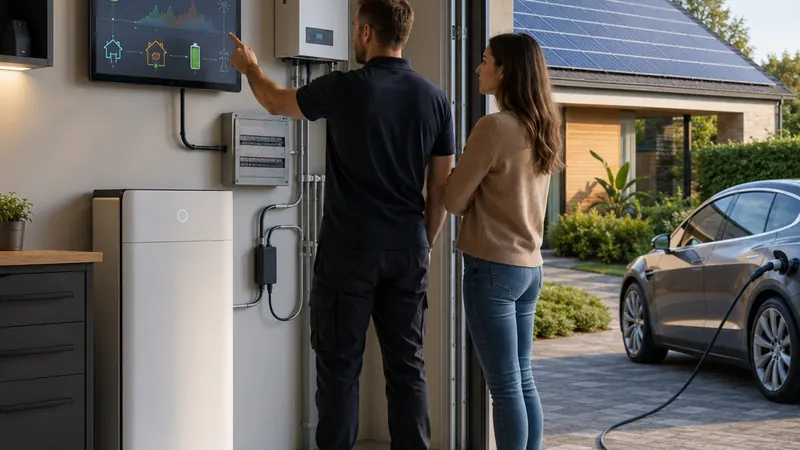
One of the latest developments in the field of batteries is the introduction of the home battery. Electricity can be stored in such a home battery to be used later. It addresses the fact that solar panels mainly generate energy when consumers are not at home. By storing this energy, they can ultimately become self-sufficient. This avoids energy having to be sold to energy suppliers at low rates and later bought back at higher prices. In addition, a home battery also provides security during power cuts. Still, there are also disadvantages to a home battery. It requires an extra investment, and moreover there is extra energy loss due to storage and conversion.
03Types of batteries
We can roughly distinguish between disposable batteries and rechargeable batteries. In both cases, the operation is based on chemical reactions. Depending on the materials used, the battery can have very different properties. We can also make a distinction according to the size of the battery.
Disposable batteries
With disposable batteries, the electrochemical reaction is not reversible. This means that they cannot be recharged and have to be replaced after a while. This is an important disadvantage compared with rechargeable batteries. Yet they also have an important advantage. They can be produced with a lower self-discharge. As a result, less energy is lost when the battery is simply lying in the cupboard. In general, disposable batteries are mainly used for devices that use a limited amount of energy, such as children's toys or remote controls.
Zinc-carbon cell
The zinc-carbon cell is the battery invented by Carl Gassner. It consists of a mass of manganese dioxide, a zinc casing and a conductive graphite rod. It delivers a nominal voltage of 1,5 volts, but they can be connected in series to reach a higher voltage. These batteries are used in alarm clocks and remote controls, among other things. An important disadvantage is that these batteries can leak. The zinc casing slowly dissolves, after which zinc chloride leaks out. That is why they have lost importance and have largely been replaced by alkaline batteries.
Alkaline battery
The alkaline battery uses alkaline potassium hydroxide, zinc powder, manganese dioxide and graphite. It delivers about 3,5 times more energy than the zinc-carbon cell. This is because an alkaline battery contains zinc powder paste and not a zinc casing like the zinc-carbon cell, with the zinc powder paste having a much larger zinc surface area. In addition, alkaline batteries are safe to use under normal circumstances, but they will eventually also start to leak.
A drawback is the environmental impact of their production. Manganese dioxide is needed, which mainly has to be imported from South Africa. Alkaline batteries can, however, be recycled. The zinc is used for roofs, among other things, and slag for road construction is made from the chemical waste.
Silver oxide battery
Silver oxide batteries use silver oxide on the one hand and zinc powder paste on the other, just as alkaline batteries do. They deliver a nominal cell voltage of 1,55 volts. These small button cells are used in watches, among other things.
Mercury-zinc battery
Mercury-zinc batteries use zinc and mercury(II) oxide, an extremely toxic and inorganic compound of oxygen with mercury. It is characterised by a low self-discharge and it has a high capacity. They can discharge for up to ten years and their operation is independent of temperature. That is why they are used in pacemakers and hearing aids, among other things. However, mercury is incredibly bad for health and the environment, and that is why these batteries have since been banned in most countries.
Rechargeable batteries
With a rechargeable battery, the chemical processes can also take place in the reverse direction, so that the battery can be recharged. These batteries are used in cars, smartphones and laptops, among other things. There are different types of rechargeable batteries, each with its own field of application, advantages and disadvantages.
Lead-acid battery
The lead-acid battery is a galvanic cell as invented by Gaston Planté, the French physicist who was also the first to discover the fossils of the flightless bird Gastornis, named after him. The lead-acid battery is the oldest type of rechargeable battery still in use. It is a wet-type battery, and that is why the battery must always stand upright. It delivers a large electric current, they can handle high loads and it has very low production costs, which is why they are often used in cars.
Nickel-cadmium battery
The nickel-cadmium battery is a rechargeable battery of the dry type. It is a fairly cheap rechargeable battery and they deliver a lot of current. Especially for heavy electric motors they are actually an ideal choice, which is why they are used in power tools, among other things. They have a self-discharge of about 10% per month. Their main disadvantage is that they use toxic cadmium. That is why they are increasingly being replaced by the nickel-metal hydride battery.
Nickel-metal hydride battery
The nickel-metal hydride battery is very similar to the nickel-cadmium battery, but the cadmium has been replaced by a hydrogen-absorbing alloy. This battery was invented in 1989 by Stanford Ovshinsky. Thanks to its unique composition it can store more energy, but it does deliver less power and has a higher self-discharge that can reach up to 20%. The absence of toxic cadmium does mean that they are becoming increasingly important. They are used in laptops and smartphones, among other things.
Nickel-hydrogen battery
The nickel-hydrogen battery uses hydrogen in a pressure vessel filled up to 82,7 bar. These batteries have an incredibly long lifespan of at least 180 months, but often much longer. Their good electrical properties make them particularly interesting for space travel. These batteries are used in the ISS, the Mars Global Surveyor and the Hubble Space Telescope, among others.
Lithium-ion battery
The lithium-ion battery is often used in model aircraft and in electric cars. It has a self-discharge of about 5 to 10% per month and a lifespan of 24 to 36 months. An important disadvantage, however, is that these batteries must never be discharged too far. That is why their devices must have their own control system to prevent this.
Lithium iron phosphate battery
The lithium iron phosphate battery or LFP battery is a battery that uses lithium iron phosphate or LiFePO4 as the cathode. It is a fairly recently developed battery. It was discovered in 1996, but for a long time practical applications did not seem possible because of the high intense resistance. Since this problem was resolved, it has started to gain importance. It has a lower cost price, it is harmless, it is safe and it has a high specific capacity. It is mainly used in cars.
Lithium-ion polymer battery
The lithium-ion polymer battery is a variant of the lithium-ion battery. It is characterised by a low self-discharge and a high energy density. Moreover, it can charge very quickly (often no longer than 90 minutes), but the lifespan is fairly short. It also does not suffer from the so-called memory effect. These batteries are used in laptops and model aircraft, among other things.
Sodium-sulphur battery
A sodium-sulphur battery is a battery designed for large-scale use. It works on the basis of liquid sodium and sulphur. It has a high energy density, it uses cheap raw materials and it can be charged and discharged without limit. On the other hand, there are a number of important disadvantages, such as fire hazard and high corrosiveness. Moreover, this battery must constantly be kept at a temperature between 300 and 350°C, even when it is not in use. For the time being it is an experimental battery with a limited number of practical applications.
Lithium-sulphur battery
A lithium-sulphur battery is a battery with limited self-discharge. It is mainly used because of the low specific mass of sulphur and lithium, which keeps the weight of the battery limited. The number of commercial applications currently remains limited. It is used, among other things, in research projects into permanently flying lightweight aircraft that charge with solar panels during the day and rely on their batteries at night. Sony, among others, has already indicated that it wants to bring commercially viable lithium-sulphur batteries to market.
Size of a battery
Batteries come in a wide range of sizes, and this should therefore be taken into account when replacing batteries. This is usually indicated in the battery compartment of the device.
AA battery
The AA battery is also sometimes called a penlite or a mignon battery. It is sometimes referred to by the international LR6 or HR6 code. These batteries work on the basis of lithium or alkaline technology and have a diameter of 14,5 mm and a height of 50,5 mm. They are used for remote controls and wireless keyboards, among other things.
AAA battery
The AAA battery has a diameter of 10,5 mm and a height of 44,5 mm. It is therefore slightly smaller than the AA battery and is used in headphones and toys, among other things. They are also sometimes called pencil batteries. Like AA batteries, these batteries use lithium and alkaline technology.
C battery
The C battery is a fairly rare battery and is also sometimes called the baby battery. It has a diameter of 26,5 mm and a height of 50 mm. These fairly thick batteries are used in measuring equipment and torches, among other things, but sometimes also in toys.
D battery
The D battery has a diameter of 34,5 mm and a height of 61,5 mm. This battery is also sometimes called a mono battery. It resembles a C battery, but is a touch thicker still. These batteries are rarely used in consumer electronics. Maglites, professional torches that are extremely powerful, are among the devices that use these batteries.
N battery
The N battery is one of the smallest batteries there is and is also sometimes called a lady battery. This small battery has a height of 29 mm and a diameter of 11,5 mm. These small batteries are used in sensors, clocks and alarm systems, among other things.
9V block battery
The 9V block battery, available in alkaline and lithium versions, is a battery for devices that use a lot of energy and require a continuous supply of power. Examples of these are smoke detectors and wireless microphones. These batteries are rectangular and measure 26,5 x 17,5 x 48 mm.
How does a battery work? Types of batteries, how they work & more!
How do batteries work? Who invented the battery? What types are there? For these and other questions ➜ EnergieAanbieding.nl ✅
04Frequently asked questions about batteries
There are different types of batteries and rechargeable batteries. These use different technologies or have different properties. Naturally, this is confusing and can raise questions. This FAQ answers the most important questions about batteries.
Various studies have been carried out into the quality of batteries. A study by Radar AVROTROS showed that expensive batteries are by no means always better. This was also confirmed by Test Aankoop, the Belgian counterpart of the Consumentenbond. In addition, a laboratory test was carried out at the Vrije Universiteit Brussel for the radio programme “De Inspecteur”. This showed that IKEA batteries scored best in terms of value for money, followed by the batteries from Kruidvat. The Duracell batteries, despite being four times more expensive than those from IKEA, finished in third place.
Is a battery from a premium brand always better?
Store batteries in a safe and dry place. Batteries like a temperature between 15 and 17°C. However, this does not mean that you should store the batteries in your garden shed or outbuilding, because it is probably too damp there. As a compromise, it is therefore often recommended to simply store the batteries at room temperature, away from heat sources and out of the sunlight. Finally, manufacturers advise keeping batteries out of the reach of children and never putting small batteries in a pill box. Apparently, every year there are people who make a mistake and swallow a battery.
How can I store batteries safely?
You hand in empty batteries at a collection bin in the shop or the supermarket. Button cells and (batteries from) old smartphones can also be handed in. Via the website www.legebatterijen.nl you can easily find a collection bin near you.
What should I do with empty batteries?
You can use a battery tester for this. Such a battery tester is available for less than a tenner. Always do this, because sometimes a battery will no longer work in a device that requires a lot of energy, but can still be used for a long time in, for example, a remote control or a kitchen scale.
How can I test a battery?
This can differ per watch. The simplest way to find out is by opening your watch. The inside indicates which type of battery you need.
Which battery fits in a watch?
Here too you will have to open it briefly to check. It is probably also simply stated in the manual that comes with your car. The batteries most often used are of the type CR2032, CR2025 and CR2016.
Which battery fits in a car key?
First and foremost, remove the battery from the device. Do not do this with bare hands, but use an apron and household gloves. Do this in a well-ventilated room where no children or pets are hanging around. Then put each battery in an individual transparent plastic bag. Clean the device with vinegar or lemon juice and take the bag to a collection point as soon as possible.
My battery has started leaking. What should I do?
Work out the monthly amount with your usage and feed-in.