Saving tips for charging your electric car
By Laurens Arends · updated 05-10-2026
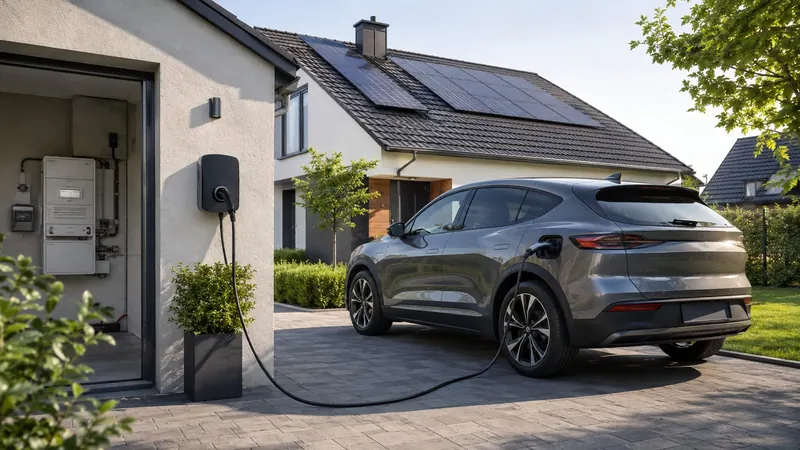
Charge during off-peak hours
If you get home at 18.00, only let the car start charging once your off-peak rate begins: usually at 23.00, but in Noord-Brabant and Limburg already at 21.00. At weekends and on public holidays the off-peak rate applies all day. Do check your contract, though. The rate comparison by Gaslicht.com of 20 May 2026 shows that some suppliers charge no price difference and that the largest difference shown is € 0,0382 per kWh. On 2.000 kWh you therefore save nothing up to € 76,40 per year. With a dynamic contract this works differently and you can save even more.
Smart charging on a dynamic contract
With a dynamic energy contract the night is not automatically the cheapest time to charge. So only set when the car needs to be full and let the charger choose the most favourable hours. An analysis of Dutch EPEX prices by Gridio yields a difference of around € 0,063 per kWh, or about € 126 on 2.000 kWh (including VAT).
This is an average difference for 2025, but this difference is also to some extent representative of 2026. The energy tax and fixed purchasing costs do not change per hour. The actual gain of course depends on the market and how many charging hours you can actually shift. Sometimes that will not work and you will simply have to charge right away, at less favourable times. At the same time, the saving can also be higher if you can charge on energy from your own solar panels (see below).
Charging at home is almost always the cheapest
According to Milieu Centraal charging at home in 2026 costs about € 0,24 per kWh, public charging € 0,49 and fast charging € 0,70. With 2.000 kWh per year you then pay € 480, € 980 and € 1.400 respectively. Charging at home thus saves € 500 to € 920 per year. This does, however, involve an investment of about € 1.300 to € 2.200 for the charging point and installation. If you save € 500 a year compared with the on-street charging point, € 1.700 is earned back in around 3,4 years. Charging card, start, parking and idle fees can make public charging even more expensive.
Even if you factor in the investment, the annual saving is still very large. This is even the case with a conservative calculation with a service life of ten years. The charging point and installation then cost the equivalent of € 130 to € 220 per year. After deducting that, you save a net € 280 to € 370 a year compared with public charging and € 700 to € 790 compared with fast charging. Your own charging point is therefore a smart investment!
Charge on your own solar power
Are you at home and is it sunny? Then plug the car in between 11.00 and 15.00 and let 500 kWh of solar power go straight from the roof to the battery. Until the end of 2026 it makes relatively little difference financially when you use that electricity, as long as you can fully net it. When feed-in charges apply, that picture will change for good.
From 1 January 2027 net metering ends after all. With a € 0,27 consumption rate and a feed-in fee of around € 0,05, direct use yields about € 110 more. This amount is in line with the contract rates for 2027 published in 2026. Be aware that the saving can rise further with dynamic feed-in fees.
Choose a charging point that steers by price or sun
Choose a charging point on which you set your departure time, battery level and price limit and that steers by solar power and household consumption via the smart meter. According to Milieu Centraal, smart charging can already steer well today by electricity price, green production and the load on your connection. Of course it is essential to be able to plan your consumption well and therefore to set your departure time and desired battery level appropriately.
How much you can save will depend on this. If, for example, you shift 1.000 kWh with a € 0,063 price difference and from 2027 also charge 500 kWh of your own solar power with a € 0,22 benefit, you save around € 173 per year. According to Homedeal, smart functions often cost € 100 to € 300 extra and therefore pay for themselves quickly. In this scenario, without subscription costs, you earn back that extra cost in about 7 to 21 months.
Do you drive for business? Arrange the charging costs properly
Indicative private costs you avoid: about € 580 per year (2026 price level).
Effort: low
If you charge a company car at home, prevent those 2.000 business kilowatt hours from quietly remaining on your private bill. At an electricity rate of € 0,29 per kWh, this amounts to € 580 per year. In this alternative, the employer settles the home charging allowance. A maximum rate may have been agreed for this.
In any case, record clearly which rate applies, who updates it and which costs are included. Keep the charging data from the charging point app per session or work with a party that does this automatically. This does not save electricity, but it does prevent you from paying in advance for the electricity for the company car. Ask your employer or lease company about the exact arrangement.
Preheat while plugged in
On a winter morning, schedule the departure time and heat the car and the battery while it is still plugged in. Preheating then does not come at the expense of your available range. A 2026 model study (Mansour, Benoit, Al Haddad et al.) found up to 7 per cent lower energy use during the journey in cold conditions.
Suppose a third of your 2.000 kWh falls in winter and 7 per cent of that prevents you from having to fast charge on the way. Using Milieu Centraal’s average charging prices, you then shift around 47 kWh from € 0,70 to € 0,24 and save about € 22. Without an avoided fast-charging stop the direct financial gain is small, but you no longer have to scrape the windows either, and that is of course already quite something.