A heat pump via the energy supplier: what do you need to know?
Sooner or later you will have to come off gas. At the same time, we Dutch need to do more to live and dwell more energy-efficiently, while energy, and gas in particular, is only becoming more expensive. These are all reasons why you might be considering a heat pump. There is of course a lot to say about such a heat pump. We explain what it is, indicate which types of heat pumps exist and answer a number of frequently asked questions about heat pumps.
01What is a heat pump?
A heat pump is an energy-efficient way to heat the home. In addition, heat pumps are used to heat domestic hot water and to heat swimming pool water. Moreover, a heat pump can even be used to cool homes during the hot summer months. It is true, however, that there are different types of heat pumps. The possibilities and the efficiency can differ greatly, while the price tag is certainly not always the same either.
How a heat pump works
There are different types of heat pumps and the practical operation differs somewhat, but the operating principle is always the same. It is based on the principle that a refrigerant extracts heat from the surroundings, just as a fridge does to remove heat from the “cabinet”. With a fridge, it takes the heat from the cabinet to the outside surroundings (often the kitchen); with a heat pump, it brings the heat from outside or from under the ground inside. Heat pumps with a cooling function use the same technology, but simply reverse the process.
A refrigerant is a liquid that already reaches a boiling point at a low temperature and then evaporates. The vapour is compressed by a compressor until it reaches a higher temperature. This compressor consumes electricity, while the remaining energy is thus extracted from the ground or from the air. Finally, the warm vapour is given off, for example to heat the air in the house or to heat the (domestic) water.
Advantages of a heat pump
There are many advantages associated with the use of a heat pump. The biggest advantage is of course the low energy consumption. Approximately four fifths of the energy required is extracted from the surroundings; only one fifth of the energy required comes from electricity. Certainly compared with electric storage heaters, but also compared with gas and oil boilers, the saving quickly adds up. As a result, a heat pump has a short payback period.
Secondly, a heat pump is environmentally friendly and sustainable. You emit less CO2 and it does not use fossil fuels. Of course, the latter does depend on the energy supplied to you. With an energy contract for green energy or with solar panels, you in any case heat your home with 100% green energy.
Furthermore, you can also use a heat pump to cool your home. This can be active or passive, depending on the type of heat pump. The maintenance costs are also actually very reasonable, certainly compared with, for example, the maintenance costs of an oil boiler. Finally, bear in mind that these many advantages are offset by a few minor disadvantages. You can read more about that in our earlier blog about the disadvantages of a heat pump.
Is a heat pump attractive for me?
Whether or not a heat pump is an attractive investment depends on a number of factors. In any case, it is important that your home is well insulated. It does not necessarily have to be a new-build home that meets the strictest insulation requirements, but without decent insulation a heat pump will not be sufficient to heat the home. A heat pump is furthermore extra attractive if you already have radiators or underfloor heating and if you have solar panels, because then you can simply generate the electricity for your heat pump yourself.
Either way, every situation is unique and the suitability of the heat pump and the ideal type of heat pump will depend on the characteristics of the home, the available budget, the insulation value of the home, the consumption, the number of rooms to be heated and so on. An expert will inform you about this.
02Types of heat pumps
If you want to have a heat pump installed, you can choose between different types of heat pumps. These are geothermal heat pumps that use ground heat as their source (ground-to-water heat pumps), air source heat pumps that use the outside air as their energy source (air-to-air heat pump, air-to-water heat pump and hybrid heat pumps) and water source heat pumps that use water as their heat source (water-to-water heat pump). Each type of heat pump has its own advantages and disadvantages. If ground drilling is needed, the price tag quickly goes up.
Air-to-air heat pump
An air-to-air heat pump is a heat pump that extracts heat and energy from the outside air. It can even do this when it is freezing outside. That is because the absolute zero of air is not 0°C, that is merely the freezing point or the point at which water freezes. The absolute zero of air is -273°C. Only at this extremely low temperature do the molecules stop moving. At anything above that they do, and then the air contains energy. The warmer it is, the more energy or heat can of course be extracted from the air and the higher the efficiency will be.
So the air-to-air heat pump extracts heat from the air by means of an outdoor unit. Using a network of pipes, this is then passed on to one or more indoor units. These indoor units then blow the warm air into the rooms. The advantage is that the operation can be reversed in summer, so that the heat pump then functions as air conditioning. An air-to-air heat pump is the cheapest solution, but the efficiency is lower than with the other heat pumps.
Air-to-water heat pump
An air-to-water heat pump works partly in the same way as an air-to-air heat pump. An air-to-water heat pump also has an outdoor unit to extract heat from the outside air. Only this heat is not blown into the home, but used to heat water in an energy-efficient way. It can for example serve as a replacement for an electric boiler or for the water of your central heating. The efficiency is lower than with water source heat pumps that require ground drilling, but at the same time it is also cheaper and simpler to realise.
Water-to-water heat pump
With a water-to-water heat pump, the heat pump is used to heat water in an environmentally friendly way, for example for the central heating. Here there is no outdoor unit that extracts the heat from the air. Instead, the heat is extracted from the groundwater. This requires ground drilling. That makes a water-to-water heat pump more expensive to realise. It does achieve the highest efficiency, though. Groundwater has a constant temperature, even when it is freezing above ground.
Ground-to-water heat pump
A ground-to-water heat pump is a heat pump that is used to heat water and that extracts the heat from the ground. Here you can choose a vertical borehole or a horizontal network of pipes in the garden. Of course you need a sufficiently large garden to be able to realise such a horizontal network of pipes. A ground-to-water heat pump requires hardly any maintenance and achieves a high efficiency, just slightly less than that of a water-to-water heat pump, while it is cheaper to realise than such a water-to-water heat pump.
Hybrid heat pump
A hybrid heat pump combines a gas condensing boiler with an air-to-water heat pump. The advantage is that the system can automatically determine the cheapest way to heat the water. If the outside temperature is very low and the efficiency of the heat pump drops too far, it can for example switch to the central heating boiler for the heating. A combination of the two is also possible. Especially for homes that are somewhat less well insulated, a hybrid heat pump is an excellent choice.
03Price of a heat pump
It is difficult to say what a heat pump costs. It depends on the type of heat pump, the space that needs heating, the difficulty of the installation, the desired number of indoor units and so on. It also remains to be seen what is already present in the home. If, for example, underfloor heating also has to be installed, prices of course rise quickly. Below are a number of guide prices, but bear in mind that these prices are purely indicative. Always request a number of quotes to get a good idea of what a heat pump costs for your home.
Subsidy for a heat pump
In the Netherlands you can get a subsidy for the purchase of a heat pump. The amount of the so-called ISDE subsidy (Investeringssubsidie duurzame energie en energiebesparing) depends on the type of heat pump and the capacity. The subsidy amounts shown below apply to 2022. We only show the from-to amounts. The exact amounts per appliance can be found on the appliance list on rvo.nl. Bear in mind that all sorts of conditions are attached to this subsidy. You can read more about these conditions on the website Milieucentraal.nl.
If you have a heat pump installed within a year and also have part of the house insulated, it is moreover possible to apply for an insulation subsidy. In addition, the energy saving loan can also be of interest.
Efficiency and payback period of a heat pump
Perhaps even more important than the purchase price of a heat pump are the efficiency and the payback period of a heat pump. An important value here is the COP (Coefficient of Performance). This value shows the ratio of the amount of heat delivered relative to the power consumed or the electricity consumption. Suppose, for example, that a heat pump yields 6 kWh of energy and consumes 1 kWh of electrical energy, then the COP is 6. The higher this value, the more energy-efficient the heat pump is and the shorter the payback period.
This COP value is not a fixed given, however. It depends not only on the characteristics of the heat pump itself, but also on the characteristics of the environment from which heat is extracted. With an air-to-air heat pump, the outside temperature will have a big influence on the COP value. With a water-to-water heat pump, the COP value will fluctuate less strongly. And all of that of course affects the payback period. Moreover, that is not the only thing that affects the payback period.
The payback period is determined on the basis of what you save and therefore on how much you consumed before the installation of the heat pump. And that in turn depends on the insulation of your home, how much of your home you heat and how you heat it. The fluctuating energy prices also influence the payback period. Against this stands the investment and the price differences associated with it, while subsidies can shorten the payback period. In other words, it is not easy to say what the payback period of a heat pump is. In general, the payback period is between 8 and 20 years, which is of course a fairly wide margin. An expert can make the necessary calculations for you and inform you in detail about the estimated payback period.
04A heat pump through the energy supplier
Some energy suppliers do more than just supply energy. They also help customers save energy. Below you can read which energy suppliers are interesting if you have a heat pump or are planning to have a heat pump installed.
Coolblue Energy
Coolblue Energy does not install heat pumps, but you can count on discounts on energy-saving products. New customers also get shop credit there. With this you can, for example, buy smart thermostats for the (underfloor) heating at an extra good price. With these smart thermostats you get even more out of your heat pump. You also get, for example, a discount on the solar panels that Coolblue Energy installs, so that your heat pump runs on 100% green energy.
More information and energy deals from Coolblue Energy
Delta Energie
Customers of Delta Energie are only too happy to make use of the Duurzame DELTA Deals, where you can count on exclusive discounts. Through Delta Energie you can, for example, buy a heat pump with a one-off discount of €100. You can also rent a heat pump with a discount of €2,50 per month. The advantage of renting a heat pump is that you can save energy without having to invest yourself. The heat pumps from Delta Energie are currently not yet available throughout the Netherlands. At the moment it is limited to the south-west of the Netherlands, in the region that stretches between Delft in the north, Tilburg and Gorinchem in the east and Terneuzen in the south.
More information and energy deals from Delta Energie
Eneco
At Eneco you benefit from advice regarding a heat pump, while you can also buy the heat pump and have it installed through Eneco. Eneco does not do this itself, however. For this, the energy supplier works together with the company Suniverse. Eneco focuses mainly on hybrid heat pumps. The advisory consultation with an expert from Suniverse is always free.
More information and energy deals from Eneco
ENGIE
The energy supplier ENGIE offers suitable advice for anyone interested in a heat pump. Thanks to the so-called heat pump check you quickly find out, for example, whether your home is suitable for a heat pump. For the purchase and installation of heat pumps, ENGIE works together with a partner. This partner also offers maintenance subscriptions.
More information and energy deals from Engie
Essent
At the energy supplier Essent it is possible to buy a heat pump and have it installed. For this, this energy supplier works together with certified service partners. Like ENGIE, Essent offers a heat pump check. Essent likewise focuses on hybrid heat pumps. These are heat pumps from the brands Techneco, Daikin and Inventum. They are good and reliable brands that according to experts are certainly worth considering.
More information and energy deals from Essent
Greenchoice
Greenchoice offers the option of buying an Elga heat pump. The Elga heat pump is a hybrid heat pump. The company also offers the option of combining this hybrid heat pump with a central heating boiler available through Greenchoice. On top of that, customers who immediately fix their energy contract for three to five years get a discount of up to €150 on the purchase of their heat pump and central heating boiler.
More information and energy deals from Greenchoice
Heat pump through the energy supplier 👉 EnergieAanbieding.nl
Various energy suppliers offer heat pumps. What is it and is it actually worthwhile? Find out on this page.
05Frequently asked questions about heat pumps
A heat pump is a completely different way of heating than what you may be used to now. Changes raise questions and so it is not so illogical that you still have one or more questions about the heat pump. Below you may find the answer.
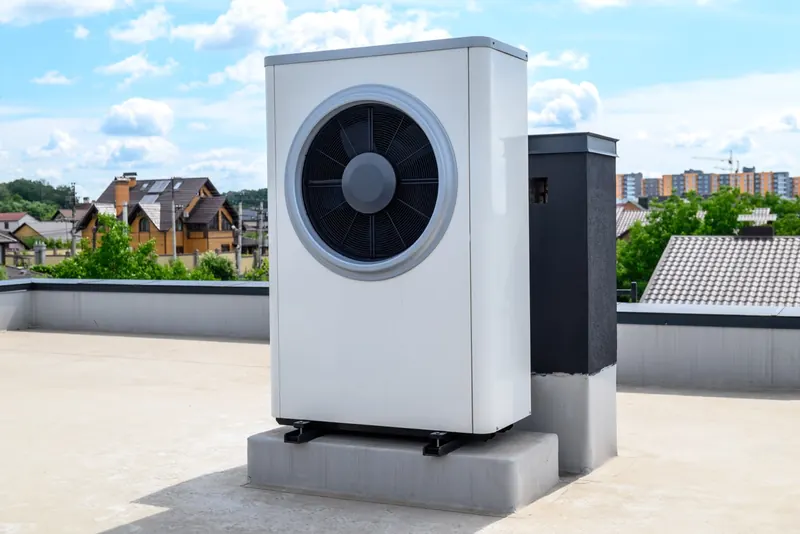
This installation can take place in different ways and locations. It can, for example, simply be placed on the ground or mounted on the facade. Furthermore, an outdoor unit can be placed on a flat roof. The choice can partly be made on visual grounds, but also bear in mind that the outdoor unit must be sufficiently accessible for maintenance work. Moreover, the outdoor unit does make some noise, which also needs to be taken into account.
Where is the outdoor unit of an air-to-air heat pump placed?
That was sometimes said in the past, because for a long time gas was up to almost five times cheaper than electricity. Nowadays, however, gas prices are going through the roof. At the time of writing, the rate for a kWh of electricity in our country varies between €0,15 and €0,62. The exact rate of course depends on the contract and when it was taken out. The price for gas varies between €0,80 and €2,79 per cubic metre of gas. A cubic metre of gas corresponds to an average of 10,2 kWh. In other words, for a kWh of gas you pay roughly €0,08 to €0,27. In other words, the difference between gas and electricity is much less pronounced than in the past. Moreover, the efficiency of an air-to-air heat pump is much higher than that of a gas installation, which makes it the more energy-efficient choice. Only at the coldest moments of the year can a gas central heating boiler be financially more advantageous than, for example, an air-to-air heat pump. If you want to reap the benefits of both a heat pump and a central heating boiler, you can also opt for a hybrid heat pump.
Is an air-to-air heat pump more expensive than a gas central heating boiler?
No, a heat pump is not suitable for homes that are poorly insulated. First arrange additional insulation and only then install a heat pump in the home.
Is a heat pump suitable for all homes?
A heat pump works best at temperatures above 2°C, after which the electricity consumption rises quickly. At lower temperatures the heat pump does still keep functioning. At temperatures below -20°C many heat pumps in principle no longer work, because the refrigerant used then no longer evaporates. In practice, manufacturers have often built in an electric auxiliary heater that takes over in such cases, so that you can still heat your home. Of course the energy consumption is then much higher. Fortunately, in the Netherlands it practically never gets colder than -20°C.
Does a heat pump still work at cold temperatures?
The outdoor unit will always produce some noise, that is normal. This noise can be experienced as disturbing, both by yourself and by your neighbours. Europe imposes upper limits. As a result, heat pumps up to 6 kW may generate up to 65 dB and heat pumps from 6 kW up to 70 dB. That is comparable to the noise of a vacuum cleaner. In practice, however, outdoor units are becoming ever quieter and often do a great deal better than what Brussels allows. That is also because the Dutch Building Decree sets requirements for the noise at the property boundary (max. 40 dB at night and 45 dB during the day). A noise level of 40 dB is experienced as very quiet and is comparable to the sound of birds at sunrise. Indoor units cause no more noise than a mechanical ventilation system. There are even whisper-quiet models that can perfectly well be placed in the bedroom.
Does an air-to-air heat pump make a lot of noise?
Work out the monthly amount with your usage and feed-in.